An accurate historical analysis requires a grammatical conversion: from the passive voice of “what did not reach us” to the restored agency of “what was actively withheld.”
I am beginning to see why I had no idea of the real impact of settler-colonialism on the Native people of this land — including the role of my own faith community, Quakers. The passive language by which settlers thought and spoke about the people they overran is not an accident of style. It is the finished product of withholding, the grammar the silence was designed to produce.
An example: “Iowa was opened to settlement.” Converted: “The United States forced the Sauk, Meskwaki, and Ioway from Iowa through coerced treaties, and sold their land to settlers — including the families whose farms I grew up among. The land is held under that taking today.”
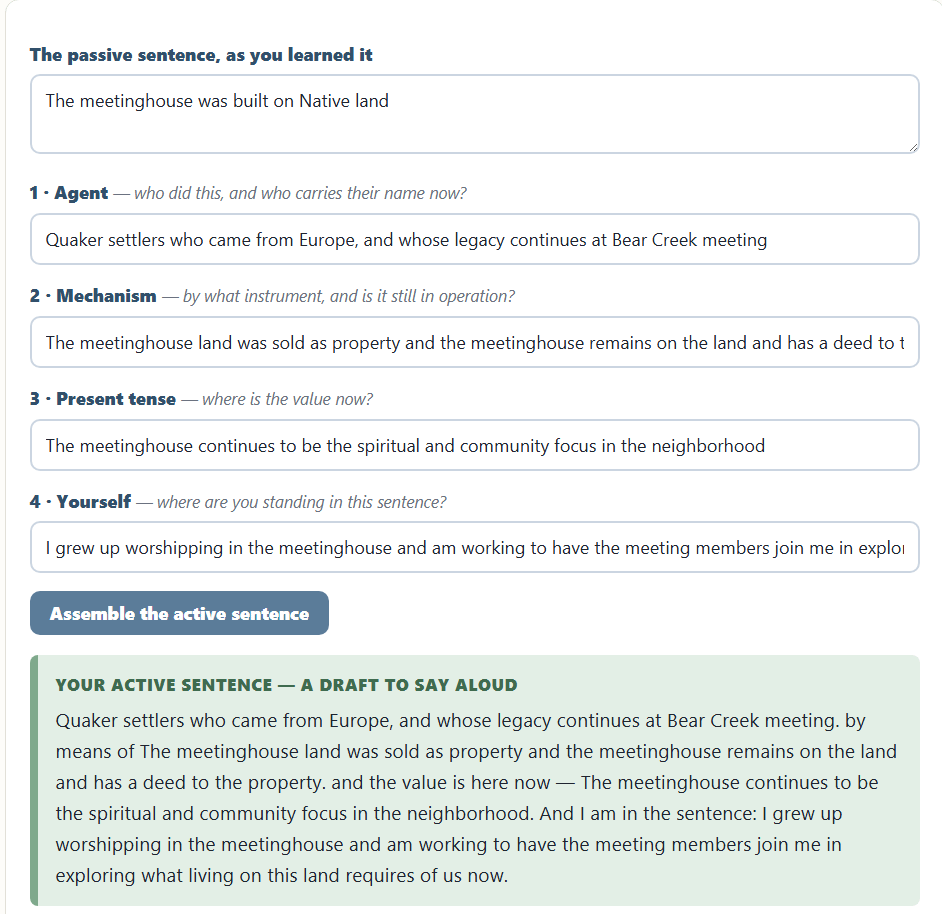
Notice what the conversion requires: an agent (the United States), a mechanism (coerced treaties), the present tense (the land is still held), and the speaker (me, in the sentence). The withholding had the same parts. Quakers operated Indian boarding schools; curricula taught the silence; my own meeting did not assign the reading. And the knowledge never went missing for Native people — they carried it, at great cost, all along. It was withheld from settlers, by settler institutions, some of which I belong to.
The language we choose will not finish the work, but it determines where the work can begin. A sentence with no agent asks nothing of anyone. A converted sentence ends with someone holding something — and what is held can be returned.
It is up to us to decide what language we will use, and that choice will determine whether we move forward in our understanding, or instead remain trapped in ignorance.
Being able to convert from “what did not reach us” to “what was actively withheld” is a practice you can learn.
This interactive web app I created will help you practice how to do this. https://kislingjeff-oss.github.io/ConversionFromPassiveToActive/
It includes an exercise for converting your own passive sentence into an active sentence. This is one of my examples:
 Channels Into Knowledge
Leave a comment